A Day of the Dead
With her warm hand she touched my forehead, I opened my eyes to look at her, and with an affectionate voice she expressed:
—Today is the visit I promised you, I will take you to the town where your great-grandparents were born.
I got up, washed up with warm water in a pewter basin at the sink, combed my hair, and was ready.
My grandmother braided her hair, tucked in her bun to adjust her comb, picked up her coin purse, her hat, and her palm-woven shopping bag with the provisions wrapped in brown butcher paper that she had bought a day earlier at the grocery store.
—Come on, let’s go.
We left the house; the morning was crisp, and the first rays of dawn filtered through the city’s gaps to unveil it. In our first few steps, we found the bakery selling the richest lard-baked bolillos I’ve ever tasted. We walked toward the park, crossing around the kiosk; on the next block was the temple of El Carmen, and as we passed, its big clock chimed the half-hour. Next was the market, confirmed by its noises and multi-layered aromas. Along the following sidewalks, the large doors of the textile factories opened to start the first shift for wool spinners and weavers, and finally, the bus stop in front of the cinema. We boarded the transport, a large vehicle with a noisy engine. The journey began, and as it advanced, we left the town behind, crossed other settlements, and upon reaching a crossroads, turned right to begin ascending a dirt road. With my small stature, I could barely see the landscape through the window; we passed by broad, dry, grayish fields—the corn harvest had just ended, and autumn made its presence known. The farmers at work gathered dry cornstalks stacked every so often, leaving the scarecrows standing alone, whose straw heads, straw hands, and large plaid shirts fascinated me.
I saw a foreman riding his dapple-gray horse, herding cattle, while shepherds walked sheep and goats searching for something to eat among the dry terrain. Each plot was divided by prickly pear cacti and maguey plants; in one of these, a tlachiquero stood with a canvas sack, a leather flask, and an acocote gourd extracting aguamiel.
Then, a vast area of trees appeared with tall pines and oaks, the shadows of their branches casting shades across our faces; I can still smell that fresh forest aroma. Several hours passed before we finally reached our destination, the last stop right at the top of the hill. We got off, and a cloud of dust blurred the surroundings. Once everything cleared, we headed down a path toward a small adobe house with a red-tiled roof sitting in the middle of the countryside. Upon arrival, my grandmother tapped on the fence gate with a coin, and immediately a large, sturdy older man appeared with dark, thick hands weathered by work and sun, a long mustache, dressed in white cotton clothes, a red bandanna around his neck, and a large palm hat:
—Welcome, this is your home, come on in to eat.
As we entered, my grandmother greeted:
—Good afternoon, here I brought you your treat—and handed the bag to the woman with long braids, dressed in a traditional wrap skirt and quexquémetl. She was cooking over a wood tlecuil stove, boiling black beans with epazote and pork rind pieces in a clay pot, while cooking tortillas and pea tlacoyos on the comal, stacking them like a small mound inside a chiquihuite basket. She shaped the dough from the metate where she ground the nixtamal with the metlapil stone; the red salsa was already prepared in the molcajete, and as a beverage, lemon grass tea served in a clay mug—a meal I will never forget.
While we enjoyed the snack, my grandmother and her relatives talked about the seed harvest while catching up on shared family news. When we finished, the gentleman told us:
—It’s time, let’s go visit the altar.
We stepped outside, walked along the stone flag path past the temazcal sweat lodge and the grain storehouse recently filled with the harvest. In the distance, church bells rang with that distinct, slow cadence that announces a passing; a cool breeze stroked our cheeks, turning them rosy. We arrived in front of a large room, and the man threw open the double doors. The sunset light barely illuminated the interior:
—Come on in, please.
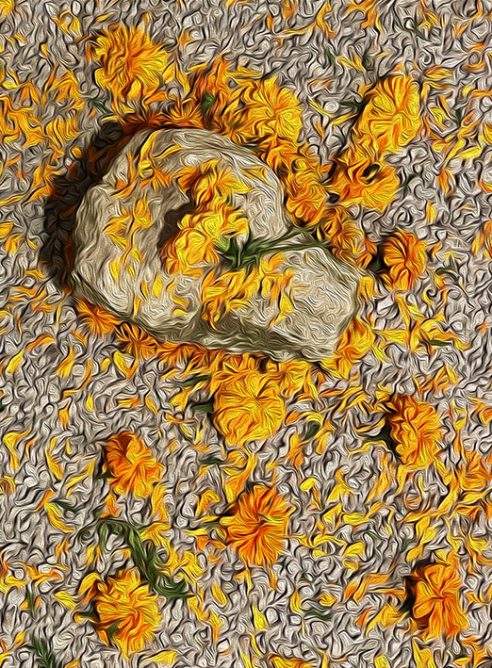
Crossing the threshold, the aroma of marigold flowers, fruit, and incense mixed with burning pitch pine calmed my soul, as a gentle voice whispered to me: “Thank you for being here.” The flickering candlelight began to reveal the grand altar. My enthusiastic eyes started exploring: the space was framed by reeds supporting a garland of marigolds alongside colorful perforated paper featuring vignettes of flowers and crosses. On the first level on the floor lay a woven mat with a small clay dish of salt as a symbol of purification, a dirt cross marking the destination at the end of life’s journey, and a glass of water to quench the thirst of the soul arriving from its long voyage to be honored. On the third level were portraits of those who departed ahead of us, some blurry, where a deep sigh catches me —finally together!—; I recognize my great-grandmothers and grandmothers by their hairstyles, my great-grandfathers and grandfathers by their hats, as well as my aunts, uncles, and a few cousins. Above sits Aunt Graciela’s egg soup—just recently a little bird told me you wanted me to know your affection; Grandmother Lala’s black sauce dishes—it was fascinating watching you pour the lard and ingredients into the hot clay pot that instantly vaporized; the Mole Poblano with the precise proportion of each of the many spices giving it that unique blend of spicy, sweet, and savory from my Aunt Cecilia—I haven’t forgotten your colorful aprons with white lace and your large wooden cooking spoons; the minced meat and pork tamales wrapped in banana leaves from Grandmother Coco—how you enjoyed watching me savor them; Grandmother Angelita’s tortilla soup, its main ingredient cut into fine strips dried in the sunlit window sill; Aunt Carmela’s coffee with evaporated milk. On the top shelf rests a glass of raw milk sweetened with honey to dip Maria cookies, the shiny purple sweet potato dessert with guava flavor glistened by lemon juice, and the pumpkin dessert with its special flavor infused by piloncillo sugar. Among the breads are the horseshoe-shaped rolls with a touch of salt, the sugar-dusted pink tlacotonales, and the traditional pan de muerto with its voluptuous form sprinkled with sesame seeds—look, here are the bone shapes, and this one is the main skull. In a special spot sit the spirits and the covers of mariachi vinyl records—you’ve flushed a little red now, you are happy.
Another part that couldn’t be missing were the work tools: wax crayons, oil paints, acrylics, and the brushes with which you masterfully caressed the canvas surface to bring your ideas to life; the fountain pen and notebook in which you poured your thoughts and stories in fine calligraphy; the wooden sewing kit with the pincushion and colored threads to mend and embroider something elegant; the hand plane and carpenter’s handsaw used to sculpt a surprise out of wood; the camera with which you captured those unrepeatable moments, and of course, our shared books couldn’t be missing—I clearly remember watching you flip through them and pause at whatever inspired a thought. And on the list, the dictionary of synonyms, because it’s important not to repeat ourselves. I still remember the days we visited the library together; I never knew which book to pick, but you always had a suggestion for me. The compendium of famous quotes that made me fall in love with them for their philosophical truth. I’m still on this search for maxims. Dondis’s manual that you can always return to when structuring a good composition regarding images; the anthology of classic short stories, my favorite being The Selfish Giant by Oscar Wilde. Sometimes I feel with the fragility of the small child, and other times with the courage of the giant. And our favorite, The Little Prince. I remember the day you gave it to me, saying: I hope you enjoy it as much as I did. The quote we agreed on in it—I can’t recall if you recited it to me or if today I want you to repeat it: «It is only with the heart that one can see rightly; what is essential is invisible to the eye».
The End.